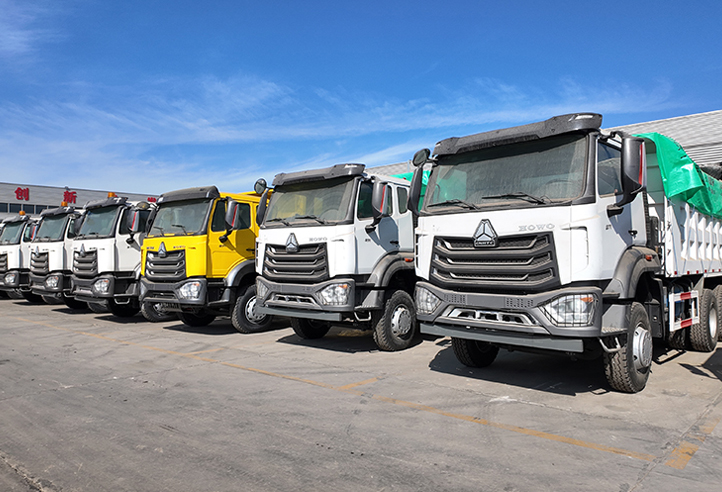
Choosing between a 6x4 and an 8x4 dump truck is not simply a matter of selecting three axles or four. The axle configuration affects payload distribution, maneuverability, traction, tire wear, fuel consumption, road suitability, and the overall economics of a hauling operation.
For contractors, fleet operators, mining companies, and construction businesses, the right configuration depends on how much material the truck must carry, where it will operate, how frequently it will travel on public roads, and what type of loading and unloading cycle it will face.
A properly selected dump truck should match the complete working environment rather than being chosen only by nominal payload. This is particularly important when comparing widely used Chinese heavy-duty platforms such as HOWO and SHACMAN, where 6x4 and 8x4 configurations are both available for different operating requirements.
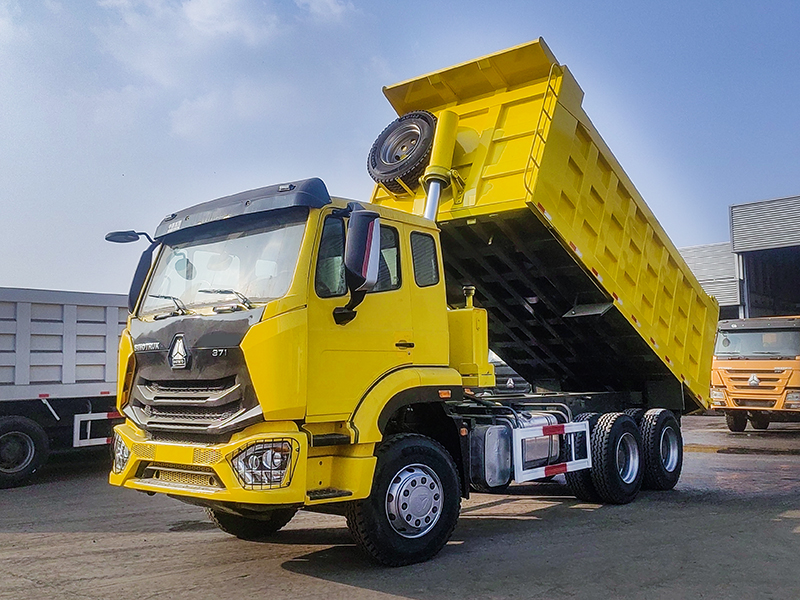
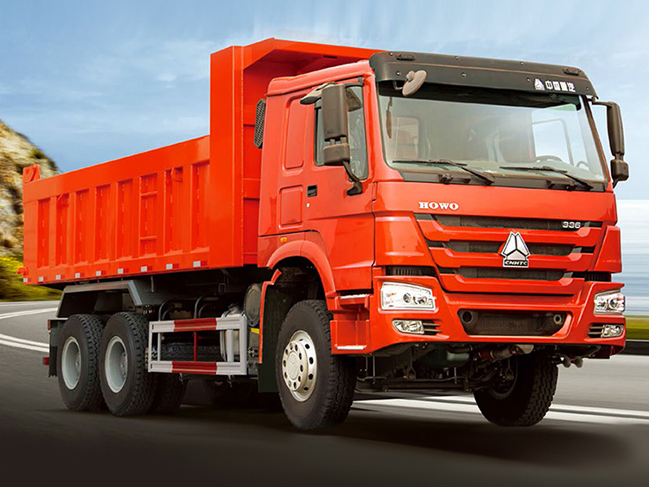
A 6x4 dump truck has six wheels or wheel positions distributed across three axles, with four driven wheels typically located on the two rear axles.
The first axle is generally the steering axle, while the two rear axles provide propulsion. This configuration has become a common choice for construction, quarrying, aggregate transportation, road building, and general heavy-duty material hauling.
The key advantage of a 6x4 layout is its balance. It provides substantial traction and carrying capability without adding the weight, length, and additional tire and axle components associated with a four-axle truck.
For projects involving frequent movement between construction sites, uneven terrain, moderate-to-heavy payloads, and a mixture of paved and unpaved roads, a 6x4 can offer a practical combination of mobility and operating efficiency.
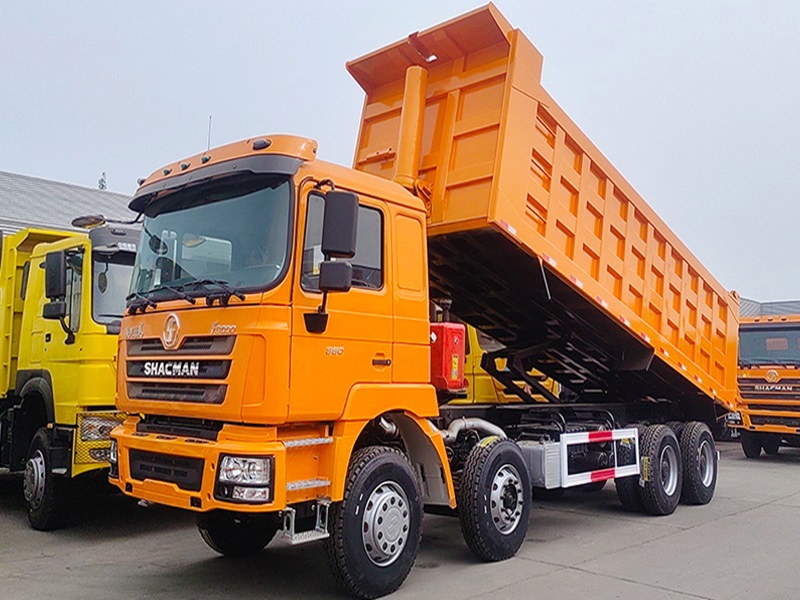
An 8x4 dump truck uses four axles, with eight wheel positions and four driven wheels.
In a typical 8x4 dump truck, the front section contains two steering axles while the rear two axles provide drive. The additional axle allows the vehicle's gross weight and payload to be distributed across more contact points.
This makes the 8x4 configuration particularly relevant to high-volume bulk-material transportation. It is commonly used for major construction projects, infrastructure development, mining-related hauling, and applications where larger payload capacity can improve the productivity of each transport cycle.
For example, Snail Truck's used HOWO and SHACMAN range includes both 6x4 and 8x4 dump truck configurations, allowing buyers to compare the chassis layout with the actual requirements of their project rather than treating all dump trucks as interchangeable.
The most important difference is the way the vehicle distributes weight and combines traction with carrying capacity.
| Factor | 6x4 Dump Truck | 8x4 Dump Truck |
|---|---|---|
| Axles | 3 | 4 |
| Driven axles | Typically 2 | Typically 2 |
| Steering axles | Typically 1 | Typically 2 |
| Payload potential | High | Generally higher |
| Maneuverability | Strong | More limited in tight areas |
| Traction | Strong | Strong |
| Weight distribution | Concentrated over fewer axles | Distributed over more axles |
| Purchase/maintenance complexity | Lower | Higher |
| Typical applications | Construction, quarrying, mixed hauling | High-volume construction, infrastructure, bulk hauling |
| Tight-site operation | More suitable | Requires more space |
The exact specifications vary by manufacturer, axle ratings, wheelbase, body dimensions, engine output, local regulations, and individual vehicle configuration. Therefore, axle count alone should never be treated as a guaranteed payload figure.
A 6x4 can be particularly practical when a project involves rough access roads, frequent turning, steep approaches, or constantly changing work areas.
Its shorter and generally more compact chassis configuration can make maneuvering easier around construction sites. When the truck must repeatedly enter and leave narrow loading areas, reverse into confined unloading zones, or negotiate temporary roads, maneuverability can directly influence cycle time.
The two driven rear axles also provide substantial traction. On loose soil, gravel, mud, and uneven construction access roads, traction can be more important than simply increasing theoretical payload.
However, the actual performance depends on more than axle configuration. Tire selection, differential locks, suspension, ground clearance, axle ratios, engine torque, and weight distribution all influence off-road behavior.
A 6x4 therefore makes sense when site mobility is a major requirement and the project does not justify maximizing payload on every trip.
An 8x4 becomes more attractive when the project prioritizes higher carrying capacity and high-volume material movement.
Consider a large infrastructure project where the truck repeatedly transports aggregates, sand, soil, crushed stone, or construction waste along relatively wide haul routes. If loading points and unloading areas have sufficient space, the additional axle can provide a useful platform for distributing the vehicle's operating weight.
This is one reason an 8x4 dump truck is often considered for large-scale hauling applications.
The potential productivity benefit comes from the transport cycle. If an 8x4 can legally and mechanically carry a greater load than a comparable 6x4, fewer trips may be required to move the same total volume.
But this calculation must include local axle-load regulations. A truck that has a larger theoretical capacity does not necessarily mean the operator can legally load it to that capacity on every road.

In many configurations, yes, an 8x4 has a higher permissible gross weight and therefore can support a larger payload than a comparable 6x4.
However, “more axles” does not automatically mean “more payload.”
The actual payload depends on:
Chassis curb weight
Front and rear axle ratings
Wheelbase
Suspension configuration
Dump body weight
Engine and transmission specification
Tire load rating
Local road regulations
Legal gross vehicle weight
Material density
For example, one cubic meter of loose sand does not weigh the same as one cubic meter of wet soil or crushed rock. A dump body that appears large enough for a certain material may exceed the truck's legal or mechanical payload once loaded.
For procurement, buyers should calculate payload based on weight, not only body volume.
Weight distribution is one of the most important technical differences between 6x4 and 8x4 dump trucks.
A 6x4 concentrates the vehicle's weight over three axles. When the dump body is heavily loaded, the rear axles can experience significant loads, particularly when the material is unevenly distributed.
An 8x4 introduces an additional front axle, allowing a greater portion of the vehicle's load to be carried by the front axle group.
This can become important when operating under axle-load regulations. Instead of asking only, “How much can the truck carry?”, fleet managers should also ask:
How is that weight distributed across the axles?
Incorrect loading can create problems even when the total gross vehicle weight appears acceptable. Excessive axle loading may accelerate tire wear, suspension wear, steering-component wear, and brake-system stress.
At first glance, an 8x4 may appear to have an advantage because it has more wheels. But the number of axles is not the same thing as the number of driven axles.
A typical 6x4 has two driven rear axles. A typical 8x4 also has two driven rear axles.
Therefore, the traction difference may be much smaller than buyers initially expect.
The practical traction of a dump truck depends on:
Driven axle configuration
Differential locks
Tire tread and compound
Tire pressure
Axle ratio
Engine torque
Road surface
Vehicle loading
Suspension setup
For muddy construction roads, a well-configured 6x4 can perform very effectively. For high-payload applications on stable haul roads, the additional front axle of an 8x4 may provide greater weight-distribution capability without necessarily providing proportionally more traction.
In tight working environments, the 6x4 generally has a packaging advantage.
Its three-axle layout can provide a relatively compact turning envelope compared with a four-axle truck with a longer wheelbase. This can matter when the vehicle operates inside urban construction sites, quarries, small loading yards, or road projects with limited space.
An 8x4 is physically larger in many configurations. Two steering axles can improve steering load distribution, but the additional axle and longer chassis can still require more space for certain maneuvers.
This is why fleet planners should examine actual site geometry before choosing a high-capacity configuration.
A truck that carries more material per trip but spends considerably longer maneuvering at the loading point may not deliver the expected productivity improvement.
Public-road operation introduces another layer of considerations.
A truck can be mechanically capable of carrying a certain payload but still be restricted by local regulations concerning:
Gross vehicle weight
Axle weight
Vehicle dimensions
Bridge restrictions
Road classifications
Tire requirements
Braking systems
Registration requirements
For international buyers, these rules can vary substantially by country.
Before ordering, the buyer should confirm the legal requirements of the destination market and compare them against the truck's axle ratings and actual configuration.
This is particularly important for used vehicles because a specification suitable for one market may not automatically comply with another market's regulations.
Fuel consumption depends on the complete vehicle configuration and operating cycle, so axle count alone cannot determine fuel economy.
However, a 6x4 can have an efficiency advantage in some applications because it may have lower curb weight and fewer components than a comparable 8x4.
Every additional axle, tire, wheel-end component, steering component, and structural element contributes to vehicle mass and mechanical resistance.
If the project involves moderate payloads and frequent empty returns, carrying unnecessary chassis weight can reduce operating efficiency.
By contrast, if an 8x4 consistently carries a significantly higher legal payload, the additional fuel consumed per trip may be offset by the larger amount of material transported.
The relevant metric is therefore not simply liters per 100 km, but:
fuel consumed per tonne of material transported.
That is a much more useful measure for fleet economics.
A 6x4 generally has fewer axle and steering components, which can simplify maintenance.
An 8x4 adds another steering axle, additional suspension and wheel-end components, and more tires. These parts introduce additional inspection and replacement requirements.
Maintenance costs should therefore be evaluated over the vehicle's entire operating cycle.
For a high-volume project where an 8x4 eliminates many transport trips, the higher maintenance complexity may be justified by productivity. For a smaller contractor with lower annual mileage, a 6x4 may provide a simpler operating structure.
When evaluating used trucks, buyers should pay particular attention to axle condition, steering components, suspension wear, differential noise, wheel-end condition, brake components, and frame integrity.
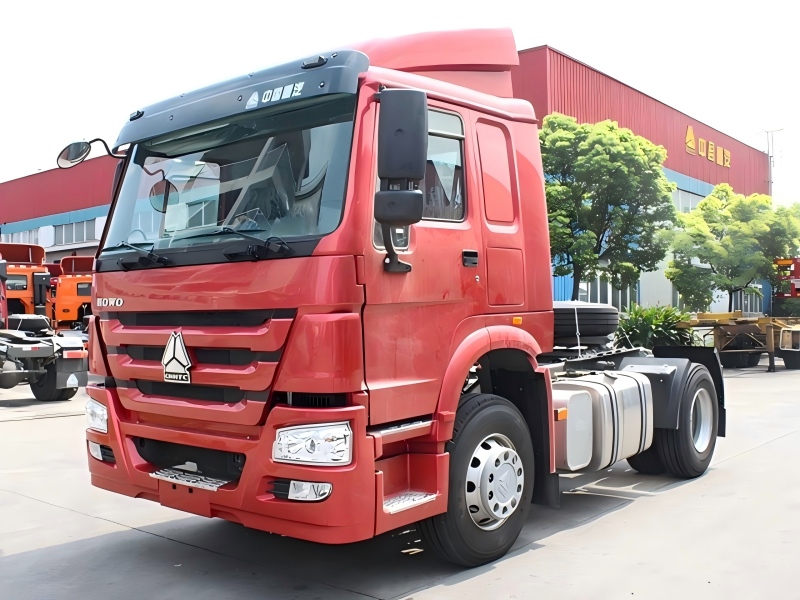
HOWO is widely used across construction and heavy-haul applications, and both configurations can serve different operating requirements.
A HOWO 6x4 dump truck can be considered when the project requires a balance of payload, traction, maneuverability, and operating flexibility.
An 8x4 configuration becomes more relevant when the primary objective is moving large quantities of bulk material and the worksite and road network can accommodate the larger vehicle.
Instead of selecting based on brand or axle count alone, buyers should compare:
payload requirement → legal axle load → road condition → site maneuverability → transport distance → annual utilization → maintenance capability.
That sequence provides a much more reliable purchasing framework.
SHACMAN is another major heavy-duty truck platform used in construction and bulk-material transportation.
The SHACMAN 8x4 configuration is particularly relevant to buyers looking for four-axle dump trucks for mining, large-scale construction, and material transportation.
Within the SHACMAN range, different cab and powertrain configurations can change the operating characteristics of the truck. F3000, M3000, and X3000 models can have different specifications depending on the specific vehicle.
For used equipment, buyers should therefore avoid relying solely on the model name. The actual chassis number, engine specification, transmission, axle configuration, body dimensions, tires, and refurbishment condition should be verified before purchase.
The inspection process should focus on components that directly affect load-bearing performance and operating reliability.
Inspect the frame rails for cracks, deformation, heavy corrosion, previous welding, and signs of accident damage.
For dump trucks, frame condition is particularly important because repeated loading and unloading creates significant structural stress.
Check for oil leaks, abnormal noise, excessive play, damaged seals, and evidence of overheating.
For 8x4 trucks, inspect both steering axles as well as the driven rear axles.
Look for worn bushings, damaged leaf springs, abnormal tire wear, and uneven suspension height.
Suspension problems can affect both ride stability and load distribution.
Inspect the floor, side walls, rear gate, hinges, subframe, and mounting points.
Heavy abrasion is common in trucks transporting aggregate and quarry materials, so body condition should be evaluated separately from chassis condition.
Check the hydraulic cylinder, hydraulic pump, hoses, fittings, control valve, and oil condition.
The dump mechanism should operate smoothly without abnormal noise, excessive leakage, or unstable lifting.
Cold-start behavior is particularly useful when inspecting a used vehicle.
Check starting performance, idle stability, exhaust behavior, oil pressure, coolant condition, transmission engagement, gear shifting, and abnormal mechanical noise.
Tire condition can represent a significant immediate cost after purchasing a used dump truck.
Inspect tread depth, sidewall damage, uneven wear, tire age, and whether the tire specifications match the intended load.
There is no universal configuration that fits every project.
A 6x4 is generally suited to operations where maneuverability, traction, flexible site access, and a balanced payload are important. It can be especially practical for construction projects involving mixed road conditions and frequent movement between work areas.
An 8x4 is generally more appropriate when the operation is centered on high-volume bulk-material transportation, higher permissible gross weight, and relatively spacious loading and unloading environments.
The correct choice should ultimately be based on the complete transport cycle rather than the number of axles alone.
Before ordering, calculate the required payload, confirm local axle-load regulations, evaluate road and site conditions, estimate annual mileage, and compare fuel and maintenance costs against expected productivity.
For buyers considering used heavy-duty equipment, Snail Truck can provide access to different HOWO and SHACMAN configurations so that the truck can be matched more closely with the intended application rather than selected purely by model designation.
The answer depends on the construction environment. A 6x4 can be practical for projects requiring maneuverability and mixed-site operation, while an 8x4 can be advantageous for high-volume material transportation where higher payload capacity is permitted.
It can, particularly when its additional chassis components increase curb weight. However, fuel efficiency should be evaluated against the amount of material transported per trip. A higher-capacity 8x4 may transport more material per cycle and therefore achieve competitive fuel consumption per tonne.
It can be used for demanding construction and quarry environments, but suitability depends on the exact chassis, tires, axle configuration, ground conditions, and site access. Extremely tight or difficult terrain may favor a more maneuverable configuration.
The additional front axle helps distribute the vehicle's weight across more axles and can support higher permissible gross vehicle weights where regulations allow it. It also affects steering and chassis dynamics.
A 6x4 can have lower maintenance complexity because it generally has fewer axle and steering components. However, actual maintenance cost depends heavily on vehicle condition, operating environment, mileage, parts availability, and maintenance history.
Compare the actual vehicle specification, chassis condition, engine and transmission, axle ratings, dump-body dimensions, hydraulic system, tire condition, service history, legal requirements in the destination country, and total landed cost. For international purchases, unit-specific inspection photos and videos are also valuable.
The choice between a 6x4 and an 8x4 dump truck should be driven by the relationship between payload, axle loading, road conditions, maneuverability, transport distance, and operating economics.
A 6x4 can provide a useful balance of traction, mobility, and carrying capability for many construction applications. An 8x4 can become more productive when high-volume material transportation and higher legal payload capacity are central to the operation.
For either configuration, the most important step is to match the actual truck specification to the project's working conditions and local regulations. For used trucks, condition verification is equally important: two vehicles with the same model and axle configuration can have very different operating value depending on their chassis, drivetrain, dump body, tires, and maintenance history.
 English